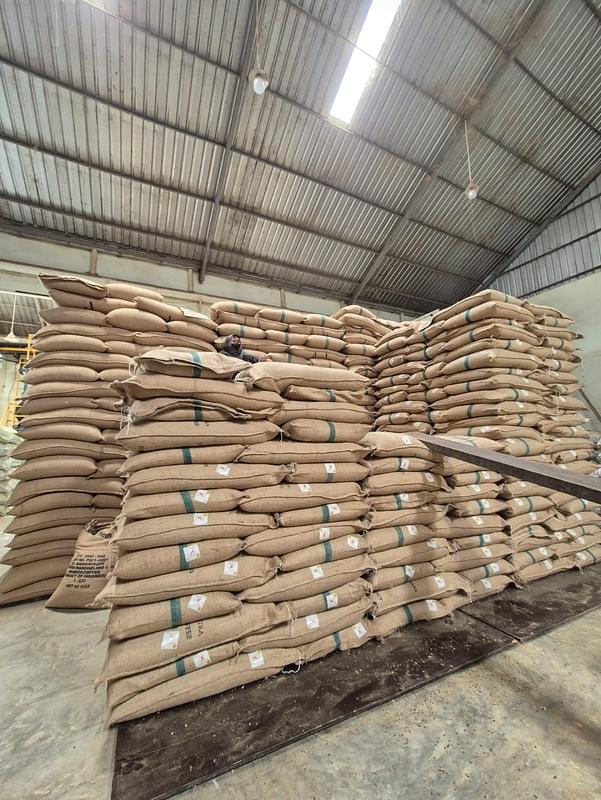
If you're a roaster, buyer, or simply someone who loves great coffee, the next few months will be unlike anything we've seen in a while. Between a crisis in the Middle East reshaping global shipping, and a fascinating story unfolding in Ethiopia's farms right now, there is a lot to unpack. Here is our honest, on-the-ground perspective.
The Middle East Conflict and What It Means for Your Coffee
By now most of you are aware that on February 28, 2026, U.S. and Israeli forces launched coordinated strikes on Iran. What followed has set off a chain of events with direct consequences for global shipping — and by extension, the cost of every container of coffee that crosses an ocean.
Iran's response has included the effective closure of the Strait of Hormuz, one of the world's most critical maritime chokepoints. Major container shipping companies — Maersk, Hapag-Lloyd, MSC, CMA CGM — have all suspended transits through the strait and the Red Sea's Bab el-Mandeb passage. With Houthi forces in Yemen simultaneously resuming attacks on commercial ships, the entire western Indian Ocean corridor has become too dangerous to operate normally. Vessels are now being rerouted around Africa's Cape of Good Hope, adding weeks to transit times and significantly increasing the cost of every voyage.
The financial hit is already visible. War-risk insurance premiums for ships operating near the strait skyrocketed almost overnight, and major marine war-risk providers began withdrawing coverage altogether for vessels in the Persian Gulf. VLCC supertanker freight rates hit an all-time record, rising more than 94% in a single day. Oil prices surged sharply, with Brent crude jumping into the high $70s to low $80s per barrel within days of the strikes, and analysts at Goldman Sachs and Barclays are openly discussing scenarios where prices breach $100/barrel if the disruption persists.
For coffee importers and roasters, here is what this translates to:
Ocean freight rates will go up. When fuel costs spike, bunker surcharges rise. When ships are rerouted around the Cape of Good Hope instead of through the Suez Canal, voyages take 10–14 additional days, consuming more fuel and tying up vessel capacity. War-risk insurance surcharges on any cargo moving through or near affected waters will be passed downstream. Anyone who locked in fixed shipping contracts in early 2026 may feel some protection in the short term — but the pressure on spot and forward rates is real and building fast.
This is a situation we are monitoring very closely, and we are doing everything we can to secure competitive freight for our customers.
Ethiopia 2025/26: A Great Harvest — With Some Important Twists
Here is where the story gets really interesting, and where our direct relationships on the ground give us a perspective you will not find in a market report.
Total Production: Excellent
Ethiopia's 2025/26 crop is shaping up to be a record. USDA projects total production at approximately 11.56 million 60-kg bags — up roughly 9% from the prior year — driven by tree rejuvenation programs, high-yield replanting across more than 450,000 hectares over the past four years, and favorable weather. Export volumes are forecast to reach 7.8 million bags, up from 7.0 million in 2024/25. From a pure volume standpoint, this is a very strong harvest.
Washed Coffee: Significantly Tighter
Here is the twist that specialty buyers need to understand: while overall volume is up, washed-process coffee will be 30–40% lower in volume compared to last year. This is not because of a production failure — it is a direct consequence of cherry prices.
Cherry prices this season are roughly 300% higher than last year. At those levels, the economics of washed processing shift dramatically. Washing stations require large amounts of fresh cherries purchased upfront in cash, before the coffee is even processed. Farmers who can't access that capital quickly or don't want to take on the risk are simply drying cherries at home instead. The result is a sharp pivot toward natural-process coffee across the country.
One exporter we spoke with described shifting his washed share from around 40–45% of his output down to roughly 20% this season — purely driven by the capital math of buying cherries at these prices. This is happening across regions.
What this means for buyers: If you need a specific washed lot — a Yirgacheffe Grade 1, a Guji washed, a particular washing station — you need to act now. Early contracting is essential this season. The washed supply is real, but it is limited, and it will be spoken for quickly.
Natural Process: The Main Story This Year
With farmers drying at home in greater numbers, naturals will dominate the offer. The good news: we are very happy with the quality we are seeing. Our on-the-ground cupping assessments are encouraging across Guji, Yirgacheffe, and Sidama. High altitude, great cherry, and a season with good drying conditions have translated into complex, fruit-forward naturals that deliver on what Ethiopian coffee is known for.
One important note for buyers sourcing naturals this year: because more coffee is being home-dried rather than processed through centralized stations, consistency and lot clarity matter more than ever. Ask about drying method, lot separation, and sorting standards. We vet everything rigorously before we bring it in.
The Government Push: Move Inventory by June 1
Ethiopia's fiscal year ends June 1, 2026. The government has been actively pushing exporters to accelerate shipments and move as much coffee as possible before that deadline. This is creating real momentum in the market — exporters are motivated, pipeline is moving, and we are working hard to position our customers to benefit from this.
In practice, this means buyers who are ready to commit within the next 6–8 weeks will have access to the best selection. Coffee that isn't contracted and moving by April will face increasing competition for the top lots.
Our Bottom Line
The market right now is a mix of tailwinds and headwinds. Ethiopian quality is exceptional — we are genuinely excited about what we're tasting. Volume is there. But freight costs are heading up, washed lots are tighter than the headline numbers suggest, and buyers who wait will have fewer good options.
If you are looking at Ethiopian naturals this season, the opportunity is strong and the quality is there. If you need washed lots, please reach out immediately — supply is limited and moving fast.
We've been doing this since 2006, our family has been in this business since 1949, and seasons like this one — complex, fast-moving, full of nuance — are exactly where those relationships and that experience make a real difference for our customers.