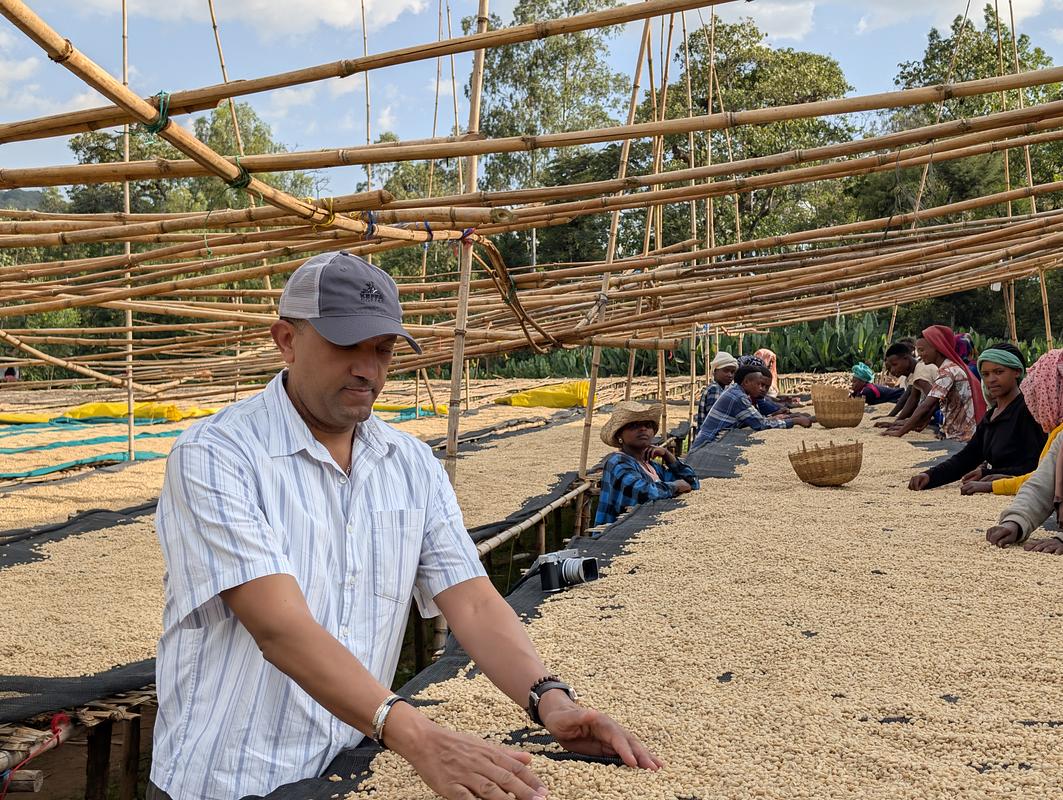
What we saw on the ground
I just got back from our January origin visit — washing stations and export mills across Guji, Yirgacheffe, and Sidamo. What we found confirms what the numbers have been suggesting, and some of it caught us off guard.
Cherry prices have tripled
Red cherry prices for washed coffee have surged from 50–80 ETB/kg last season to 190–230 ETB/kg this year. One exporter we spoke with reported peaks of $1.51 USD per kilogram, up from $0.45 last season. That’s not a modest increase — it changes the economics at every point in the chain.
The drivers are stacking: the birr devaluation, elevated global C-market prices, and rising labor costs at washing stations. Every link in the supply chain is absorbing higher costs simultaneously.
What we saw region by region
The situation isn’t uniform across Ethiopia’s growing regions. In Yirgacheffe, where washed processing has traditionally dominated, washing station operators are struggling hardest — the premium they need to charge for washed lots is pushing some buyers toward other origins entirely. Guji stations are in a similar bind, though the region’s growing reputation for high-scoring naturals is giving producers an alternative path. Sidamo is seeing the most volume shift toward home-dried naturals, partly because the cooperative infrastructure there makes it easier for farmers to dry and sell independently.
Less washed Ethiopian coffee, more natural
Here’s the thing that will affect your lineup most directly: farmers are increasingly drying cherries at home rather than delivering to washing stations. The math is simple — washed processing requires immediate cash outlay that many farmers and station operators can’t sustain at current cherry prices. The cost of buying cherries, depulping, fermenting, and washing has become prohibitive.
For roasters, the practical difference matters. Washed Ethiopian coffees — the clean, bright, citrus-and-floral profiles from Yirgacheffe and Guji that anchor many single-origin programs — will be harder to source. Natural process Ethiopian coffees tend toward heavier fruit, berry, and wine notes. Both are excellent, but they’re not interchangeable on a menu. If your customers expect a specific washed Ethiopian profile, plan accordingly.
What this means in practice:
- Washed supply will be tight. The clean, bright washed Yirgacheffe and Guji lots that many of you build your programs around will be significantly harder to source this season.
- Naturals will dominate. Farmers drying on raised beds at home means natural lots are the primary offering from Ethiopia this year.
- FOB prices are at historic highs. One cooperative general manager told us their break-even is $5.10/lb. Organic certified lots are opening around $5.60/lb, up from ~$4.66/lb last year.
- Holding is widespread. Exporters describe a “hold and wait” mood across the supply chain. Coffee gets released later and less predictably, which makes planning harder for everyone downstream.
USDA forecasts Ethiopia hitting record production in the 2025/26 season, with exports expected to reach 7.8 million bags — up 800,000 from last year. But the composition has shifted heavily toward naturals. More total Ethiopian green coffee, but not necessarily more of the coffee you’re used to buying.
What we’re doing about it
We’ve already started pre-contracting washed lots from our long-term export partners. If you need specific washed Ethiopian profiles for your lineup, reach out now — allocation will get tighter as the season progresses, not looser.
On the natural side, the offerings this year look excellent. If you’ve been running a small natural Ethiopian program, this is a good season to expand it. The volume is there and the quality is strong.
What this means for the 2025/26 season
Global stocks are still historically low, prices are elevated, and climate risk hasn’t gone away. In Ethiopia specifically, the shift toward natural processing and rising FOB prices will define this harvest season.
Our advice: plan early, contract early, and tell us what you need. The window to secure the best lots narrows every week.
If you want to evaluate what’s coming in, request samples or reach out directly. We’ll send specs and current pricing the same day.