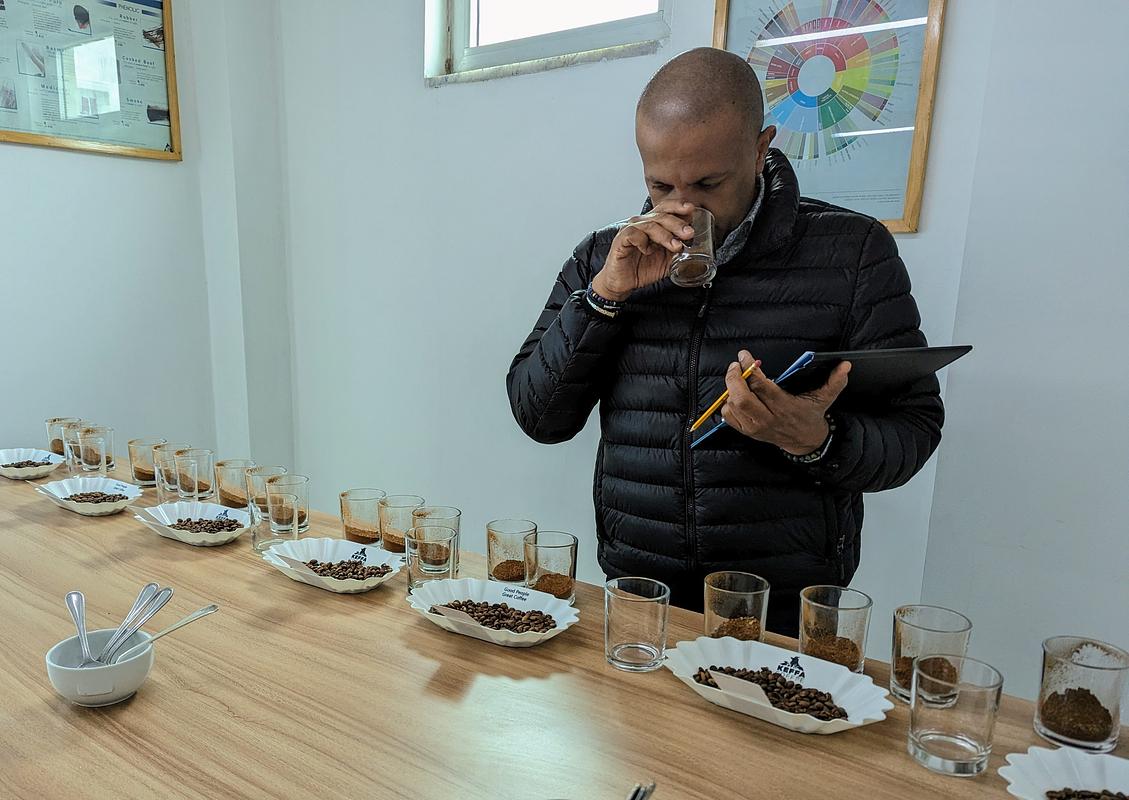
Every few weeks I get the same question from roasters, usually over a cupping table or a quick call: "Sam, where is this market going?" It's a fair question, and right now the answer is more interesting than it's been in a while. So I went through the latest coffee news this week and pulled out the three things I think actually matter for the people we serve. Here they are, with my honest read on each.
The C-market has finally come back down to earth
If you've been holding your breath through the last two years of sky-high prices, you can let some of it out. Arabica futures have pulled back to a roughly 1.5-year low, and the reason is simple: Brazil is about to bring in a monster crop. Most of the big forecasters are projecting a record 2026/27 Brazilian harvest somewhere around 75 million bags, and several analysts now expect a meaningful global surplus this year.
For roasters, this is good news after a long stretch of pain. Green coffee should get a little easier on the wallet, and the wild swings we've been living with should start to calm down. But I'll add my usual caution, because you've heard me say it before: a big Brazil crop moves the commodity number, not the specialty one. The coffees we care about at Keffa — the washed Yirgacheffe, the natural Sidama our Ardi — don't trade on the C-market alone. They trade on quality, relationships, and scarcity, and those don't go on sale just because Brazil had a good rain year. If anything, a softer market is the right moment to lock in the lots you actually love instead of chasing price.
A new coffee species just showed up — and it could matter for all of us
This one made me sit up. Researchers at Kew Gardens in London just published work on a new hybrid they're calling Libex — a cross of Liberica and Excelsa. The headline isn't the taste (though early tasters apparently find it more palatable than Liberica). The headline is where it can grow. Libex looks like it can thrive in places where Arabica and robusta struggle, it carries leaf-rust resistance, it yields better than Liberica, and its smaller seed and thinner parchment make it far easier to process and roast.
The story I'm watching most closely: Ethiopia
Now the part that's closest to my heart. While the commodity headlines were about Brazil, Ethiopia has been quietly having one of its best stretches in years. The government reported record coffee export earnings — over $2.65 billion in the last fiscal year — and Ethiopia has been one of the origins driving global export growth alongside Brazil. On top of that, China just cut all tariffs on Ethiopian imports, coffee included, which opens an enormous new door for our origin.
I've spent my whole life around Ethiopian coffee, going back to my family's roots in 1949, and I can tell you this momentum is real. Demand is broadening, the quality keeps rising, and analysts now expect the share of Ethiopian Arabica grown on genuinely suitable land to climb significantly in the years ahead. That's the kind of foundation that makes me comfortable doing what we do — committing early, buying deep, and standing behind our Ardi the way we have for 16-plus years of 92+ scores.
But let me put down the market talk for a second, because none of this matters if the coffee in the cup doesn't deliver. And it does. Take the washed Yirgacheffe — independent reviewers have scored cups from this region as high as 95 points, with the kind of profile that explains why people fall in love with Ethiopia in the first place: bergamot and nectarine up front, cocoa nib and hazelnut butter underneath, a whisper of florals, juicy acidity, and a silky body that carries into a long, bright finish. That's a classic washed cup doing exactly what it's supposed to do.
Then there's our Ardi, the natural-process coffee from the Guji Zone that I'll always be partial to. When reviewers describe it, the words keep landing in the same place — intense, original, complex. Fresh-cut cedar, grape, blueberry, brandy, a roasted cocoa-nib sweetness, with a dry, berry-toned acidity and a finish that resolves toward fruit-laced chocolate. That cup earned its 92 points honestly. And what I love is that even the lighter, more delicate lots of Ardi keep that signature blueberry sweetness while taking on an almost tea-like, airy body — clean, refreshing, the kind of cup that makes you slow down and pay attention. Two very different expressions, one unmistakable origin.